Platon Kovaloff
The NosePlaton Kovaloff’s missing nose turns a bodily loss into a crisis of public identity: he fears not only that his face has been altered, but that he can no longer appear in society, advance his career, or pursue a suitable marriage. The nose itself moves through the city with the authority of a state councillor, while the man it belongs to is left pleading with officials who reject his account. His predicament makes rank and recognition as consequential as physical possession, even as the absurdity of the events resists explanation.
Identity and Social Ambition
Kovaloff is a member of the Municipal Committee who had previously served as a committee-man in the Caucasus. Though he retained that title in memory, he preferred to call himself “Major,” a choice that enhanced his importance in his own eyes. His habits make rank visible in ordinary encounters: he directs an old woman selling shirt-fronts to ask for Major Kovaloff at his house on Sadovaia Street, and he takes a daily walk on the Neffsky Avenue in a remarkably clean, stiff collar. His whiskers, seals, and self-conscious presentation belong to the same effort to be recognized as a person of standing.
His ambitions extend beyond the title he uses. Kovaloff has come to St Petersburg hoping to obtain a position commensurate with his rank, preferably vice-governor of a province, though he would accept a bailiff’s post in a department. He is also open to marriage, but only to a woman whose dowry is two hundred thousand roubles. Career, courtship, and appearance are thus bound together in his calculations: social position is something to pursue and display, and a face without a nose threatens the whole arrangement.
The Loss and the Nose’s New Rank
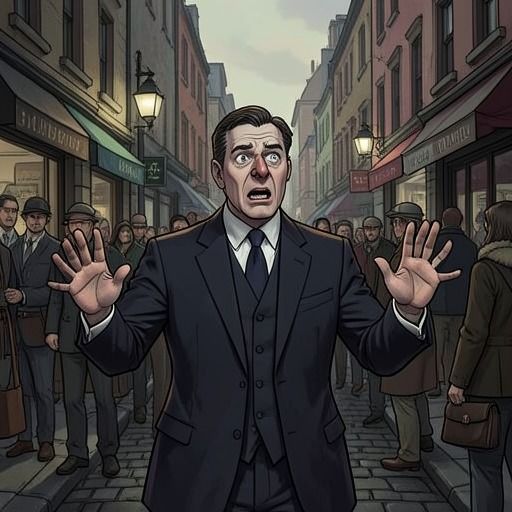
One morning, after making his habitual “Brr! Brr!” noise through his lips, Kovaloff asks for a little mirror to inspect a heat-boil that had appeared on his nose the previous evening. Instead he sees a perfectly smooth vacancy. He rubs his eyes, checks again, and finds the loss unchanged; alarmed, he dresses and sets out for the police superintendent. With no droshky in the street, he must walk, holding a handkerchief to his face as though his nose were bleeding. At a confectioner’s, he uses another mirror to confirm the absence, then leaves resolved not to look at or smile at anyone.
The sight of a uniformed gentleman emerging from a carriage overturns his hope that the loss might be a private illusion: the gentleman is his own nose. Kovaloff follows it to the Grand Bazar of Moscow, where it stands inspecting shop wares, dressed in a gold-embroidered uniform, high stiff collar, chamois-leather trousers, and sword. Its plumed hat signifies the rank of state councillor. The nose calls for its carriage and departs on duty-calls, apparently moving through the city with a social authority above its former owner’s.
When Kovaloff confronts it, the nose denies their relation. It insists that it is itself and argues that the buttons on Kovaloff’s uniform place him in a different department. The exchange makes the absurd separation legible through the very bureaucratic distinctions Kovaloff values: the nose uses rank and departmental affiliation to refuse the bodily bond. It turns away, and when Kovaloff tries to call it a scoundrel and expose it as his own nose, it has already disappeared again.
Seeking Recognition and Redress
Kovaloff’s attempts to recover the nose repeatedly collide with other people’s classifications of his problem. At the advertisement office, he asks to publish a notice offering a reward to whoever brings the runaway back. He does not want his name printed, explaining that he has many lady friends, including Madame Tchektyriev, the wife of a state councillor, and Madame Podtotchina, a colonel’s wife. He asks to be identified simply as a committee-man or, preferably, as a Major. Even in seeking help, he tries to protect the very public identity the loss has made difficult to sustain.
The official refuses the advertisement because it might compromise the paper. He invokes a previous notice about a lost black-haired poodle, which had been understood as a satire on a cashier, and treats Kovaloff’s request as a possible repetition of such nonsense. Kovaloff insists that he is speaking of his own nose, “almost myself,” but the official will not print it. The appeal fails not because Kovaloff can offer no account of his loss, but because the institution regards the account as a threat to its credibility and cannot accommodate its extraordinary premise.
He next goes to the police commissary, who is reclining after a meal and pleased by the prospect of making money. The commissary gives him a cold reception, says the afternoon is unsuitable for a case, and remarks that respectable people do not have their noses stolen. That last suggestion wounds Kovaloff more than a personal insult would: he is especially sensitive to reflections on his rank and social position. He raises his head proudly, says that he has nothing more to discuss after such insulting expressions, and leaves. The police encounter turns his misfortune into a question of respectability, then denies him the respect he expects his status to command.
His concern is also sharply social. Kovaloff says that he cannot appear before the women he visits without his nose, and worries about his regular Thursday call on Madame Tchektyriev and his acquaintance with Madame Podtotchina and her pretty daughter. In a letter to Alexandra Podtotchina, he accuses her of arranging the nose’s separation and its appearances in an official disguise through unholy spells. He warns that the story will not make him marry her daughter and threatens legal action if the nose is not restored that day. The letter shows how quickly his effort to explain the event becomes entangled with courtship and suspicion; the evidence establishes the accusation, not that Alexandra caused the loss.
Failed Repair and Unexplained Return
A doctor examines Kovaloff after the nose has been returned to him, but cannot make it stay in place. It seems wooden and falls back onto the table with a sound like a cork; repeated efforts to attach it fail. Kovaloff summons the doctor from the finest flat in the mansion. The doctor tests the vacant place with a series of finger-flicks, making Kovaloff jerk his head back hard enough to strike the wall, then concludes that the nose cannot be replaced and warns that an attempted remedy might be worse than the disease.
Kovaloff rejects the comfort of remaining as he is. He asks how he can continue without a nose when he goes into good society and has two parties to attend that evening. He again names Madame Tchektyriev and Madame Podtotchina, adding that he now wants dealings with the latter only through the police. The doctor recommends washing the place with cold water and preserving the nose in spirits or warm vinegar mixed with two spoonfuls of brandy; he even offers to buy it, provided the price is not too high. His advice treats the strange loss as something to manage or profit from rather than restore, leaving Kovaloff without the remedy he came to seek.
The narrative later reports that the same nose that had masqueraded as a state councillor is found in its proper place between Kovaloff’s cheeks, “as if nothing had happened.” This occurs on 7 April. Kovaloff wakes, happens by chance to look in a mirror, and finds his nose there. He touches it, asks Ivan for water, washes, dries his face, and checks the mirror again; each confirmation establishes the return as firmly as his earlier checks established the absence. The episode gives no explanation for either the departure or the restoration. His face is whole again, but the recovery does not resolve the story’s comic tension between bodily fact and social authority: for a time, the detached nose possessed the higher rank and easier access that Kovaloff had pursued for himself.